In this article
Recovering failed subscription payments does not start with more reminders or unlimited charge attempts. It starts by separating a recoverable failure, a payment method that needs updating, and a customer who wants to stop. Give each situation a bounded path, then measure the additional contribution after collection and service costs rather than treating all recovered revenue as a gain.
For a service business or subscription platform in Qatar and the Gulf, this differs from customer acquisition or checkout optimization. The customer already has a recurring relationship, but a failed renewal can conceal the difference between involuntary loss and deliberate cancellation. If failures occur on the first purchase, begin with diagnosing checkout friction instead.
Track the invoice, not just the attempts
Give each payable invoice a stable identifier linking payment attempts, messages, payment-method updates and subscription status. Record the first failure time, amount, failure category supplied by the payment provider, and latest known state. A second attempt is not a new invoice, and the recovery process has not succeeded until payment is settled and duplicate collection has been ruled out.
Retain only the operational information the team needs. Do not move card numbers into shared spreadsheets or support conversations. Use a secure payment-update page supplied by your approved provider. If a delayed failure notification arrives after a success notification, reconcile the invoice’s final state before triggering another message or charge attempt.
Build three paths, not one universal sequence
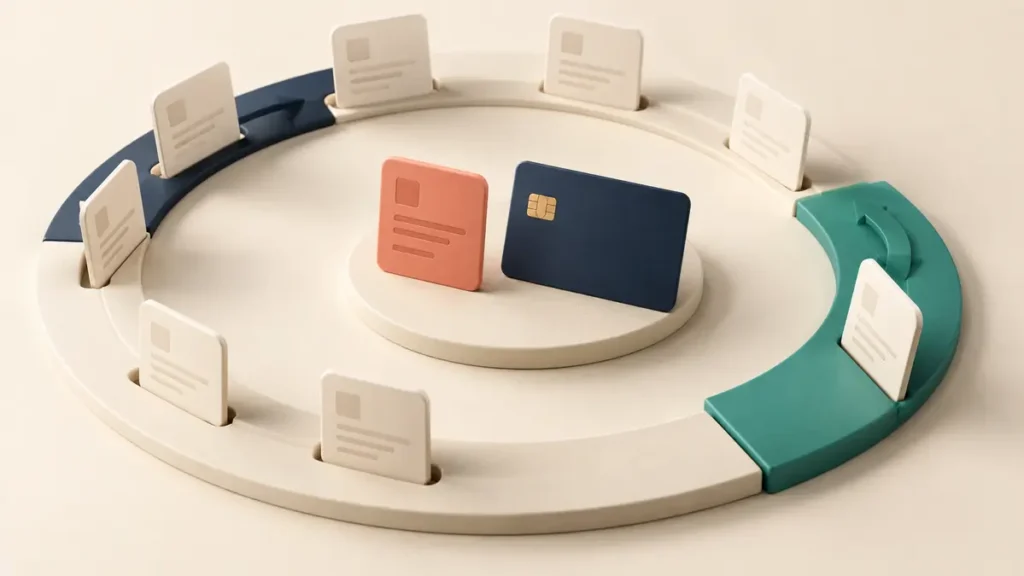
The first path covers failures eligible for a later retry under the provider’s rules, such as some temporary insufficient-funds situations. The second requires customer action to update a payment method or complete a required step. The third stops automated collection, including confirmed cancellation or withdrawn authorization. Refer ambiguous cases to the appropriate team instead of simply increasing retries.
Stripe’s official retry documentation explains that certain hard declines need a new payment method before another charge can execute, and that a scheduled attempt does not necessarily mean a charge occurred. This illustrates why provider-specific rules matter; it is neither a provider recommendation nor a claim that Stripe is available to your Qatar business. Check the documentation for your contracted provider.
Do not turn a technical code into an accusation. “We could not renew your subscription; update your payment method here” is more useful than assuming the customer lacks funds or exposing a sensitive reason. Clearly state the amount, billing period, service consequence and routes to help or cancellation.
Bound the time, attempts and communication
Assign a process owner and a fixed measurement window. A team might test a 14-day window with an initial message and one reminder, within its provider’s rules and the customer’s authorization. That is a hypothetical experiment design, not a universal recommendation for retry counts or grace periods. Appropriate limits depend on the contract, service sensitivity and delivery costs.
Track executed attempts separately from scheduled attempts. Set a combined contact limit across email, messaging and support so three systems do not send three reminders on the same day. Stop the sequence after settled payment, confirmed cancellation or expiry of the window. Check for payment through another channel before attempting to collect an invoice again.
Agree in advance what service remains available during the failure period: limited continuation, read-only access or clearly communicated suspension, consistent with the existing agreement. Do not quietly change this policy while testing reminders. Otherwise you cannot separate collection effects from the cost of providing additional service.
A hypothetical experiment: not all recovered cash is incremental
Assume 1,000 comparable failed invoices, each worth QAR 200, are randomly assigned to two groups of 500. The control group retains the existing service and collection process. Within 14 days it recovers 180 invoices; the new process recovers 230. These are teaching assumptions, not results from an actual business.
- Recovery rates are 36% and 46%, a difference of 10 percentage points.
- The test group recovers 50 additional invoices worth QAR 10,000, not an incremental QAR 46,000 merely because the new process collected that total.
- Assume invoice contribution after variable service costs and ordinary payment fees is 60% of value. Additional contribution is QAR 6,000.
- If incremental messaging, review and extra-attempt fees total QAR 1,500, net additional contribution is QAR 4,500.
Under these assumptions, roughly 13 additional invoices cover the cost: QAR 1,500 divided by QAR 120 is 12.5 invoices. This is an economic break-even point, not statistical proof. Recalculate if service margins differ or later refunds appear. Do not automatically multiply the result across the entire customer base; failure categories and invoice values may differ.
Watch the harm that recovery rates hide
Report recovery by failure age and cause, time to settlement, contacts per invoice, complaints, duplicate payments and subsequent refunds. Keep payment failure separate from voluntary cancellation. To judge whether a recovered customer stays, use a window aligned with the customer’s natural buying cycle, rather than celebrating one successful charge.
An experiment can look successful because the new group contains easier cases or because the control group received less follow-up time. Keep observation windows equal, balance failure categories and invoice amounts, and show sample size and uncertainty before scaling. Stop if duplicate collection increases or cancellation requests cannot be honored, even when recovered cash rises.
The operating decision
Start with one clearly defined failure segment, review provider rules, and give support a case list and explicit stop path. Expand only when additional contribution improves without breaching complaint or incorrect-collection limits. The aim is to preserve a relationship the customer wants, not to turn a failed payment into a pressure sequence that is difficult to escape.




 Contact on WhatsApp